Tower Rush Symbols and Paytable
Tower Rush is a fast Galaxsys game with a simple scoring structure built around stacked floors and multiplying outcomes. This page explains the symbols and paytable section in practical terms, including how bonus floors fit into the round and what to check before you play on mobile.
Symbols and Paytable format and core rules

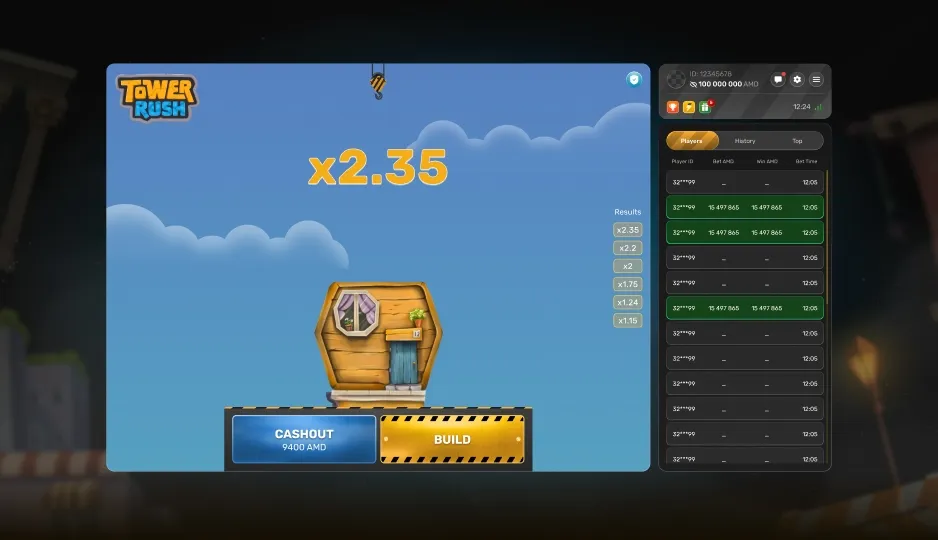
This game is built around floor placement instead of a traditional reel grid, so the paytable follows the floors you add and the multiplier attached to each one. Every floor added successfully increases the multiplier total, and the values combine together. In practical terms, each finished step alters the round value, so the paytable is easier to understand as a chain of outcomes than as a fixed symbol table.
The main rule is easy to follow: you add floors and try not to trigger a collapse. When the round keeps going and another floor lands correctly, the running value shifts again. When you stop and take the result, the stake returns multiplied by the current multiplier. That is the key payout link to know before starting a round.
Because the game belongs to Galaxsys’ Fast / Turbo Games category, the format is built for short rounds and quick decisions. The paytable therefore matters less as a long reference sheet and more as a live guide to how the multiplier grows during each run.
| Part of the round | What it means for the player |
|---|---|
| Placed floor | Adds a multiplier to the round and increases the accumulated value. |
| Cash out | Ends the round and pays the stake multiplied by the current accumulated multiplier. |
The clearest way to understand the structure is to keep the stake and the result separate. Your stake is the amount you begin with in a round, while the payout is the amount shown when you stop at the current multiplier. This difference matters because a larger running multiplier does not turn into a payout until you decide to end the round.
Symbols and Paytable risk, pace, and session planning
The pace is fast, so decisions come quickly and the round does not linger. That makes planning useful even in a simple symbol system. Before starting, decide how much of your session budget you want to place in one round, then treat the outcome as a short cycle rather than a drawn-out session.
Since the round can end if the stack collapses, the practical risk point is not hidden in small print; it sits in the act of continuing. A longer run may build a larger accumulated multiplier, but every additional floor is part of the same live round and therefore part of the same decision process. For that reason, many players prefer to decide in advance when they would be satisfied with a result.
It also helps to keep the paytable in the same frame as the game’s release profile. Tower Rush was released on 2024-02-28, so the current format is a relatively recent one within Galaxsys’ fast-game line. That is useful only as context: the game remains a quick, multiplier-based format, not a long rule-heavy title.
| Planning point | Practical use |
|---|---|
| Session budget | Set a fixed amount for the session before you start, then use that amount only for play. |
| Target outcome | Decide in advance when a multiplier result feels acceptable, so you are not deciding under pressure. |
If you want to compare this structure with other fast titles, focus on the rhythm of building and stopping rather than on a traditional symbol list. The important question is how the multiplier changes from one successful placement to the next and how quickly you are prepared to stop.
How Symbols and Paytable works on mobile
The game has a mobile demo, so the paytable and floor flow can be checked on a phone before using any real balance. That is useful if you want to understand the round sequence in a smaller format. Mobile play should be approached the same way as desktop play: read the stake, follow the multiplier changes, and check the point at which cash out becomes available in the round.
On a mobile screen, the clearest habit is to keep the round state visible and avoid rushing the decision. Because the game is fast, small screens can make it easy to move too quickly through the live round. Take a moment to check the current accumulated multiplier before each decision.
The app availability noted for the title also makes mobile access relevant, but the game page itself should still be reviewed for the exact play flow. Availability on a device does not change the rules of the round. It only changes where you can open the game and check the symbols and paytable display.
| Mobile point | What to check |
|---|---|
| Demo mode | Use the demo to learn the floor sequence and see how the accumulated multiplier changes. |
| Screen space | Keep the current round state in view so you can read the multiplier before acting. |
If you prefer to play on a smaller device, the mobile demo is the safest place to learn the sequence. It lets you observe the same floor-based structure without rushing into a live session. That is especially useful in a game where the action moves quickly and the round value updates on each successful placement.
Symbols and Paytable bonus and balance checks
The game includes three named bonus floors: Frozen Floor, Temple Floor, and Triple Build. These are the only bonus-floor names supported here, so the safest way to think about them is as special floor types within the same stacking structure. The page does not need extra assumptions about how they behave beyond their names and their place in the round flow.
Check your balance before a session begins, not while a decision is in progress. First confirm the amount you are ready to stake. Then make sure you understand how the game works out the final payout: the stake is multiplied by the running multiplier when you stop. That does not mean a guaranteed return; it only describes how the payout is calculated.
The reported RTP range is 96.2% to 97.6%. RTP is a long-term statistical return figure, not a promise for one session, and it should not be confused with a player’s guaranteed result. Use it as background information only, while your actual session control should rely on budget and timing.
For players in Pakistan who want to check a named casino listing, Mostbet is the only confirmed option in the supplied casino data. That matters as a reader action, not as a promise of wider availability elsewhere. Search the operator’s own catalogue if you want to see whether the game appears in its local game list.
| Support point | Use in play |
|---|---|
| Bonus floors | Frozen Floor, Temple Floor, and Triple Build are the named bonus floors. |
| RTP | Use the 96.2%–97.6% range as background context, not as a session guarantee. |
Common Symbols and Paytable mistakes
One common mistake is reading the floor system like a standard slot paytable. This title does not use a classic reel-and-line description in the evidence provided, so it is better to focus on floor placement, accumulation, and cash out. Treat the paytable as a live multiplier sequence, not as a list of symbol combinations.
Another mistake is mixing up stake and deposit. Your stake is the amount you place into a round, while a deposit is an account funding action outside the round. Keeping those terms separate helps you read the session correctly and avoid budgeting errors.
A third mistake is assuming the cash-out amount is a separate bonus or account withdrawal. In this game, cashing out pays the stake multiplied by the accumulated multiplier. That is a round result, not an operator withdrawal. Account withdrawals belong to the casino, not to the game itself.
It is also easy to overread the bonus floor names. The names alone do not justify extra assumptions about odds, triggers, or special rules that are not stated. Stay with the confirmed structure: the game stacks floors, adds multipliers, and may include the named bonus floors within that format.
Does the game use a traditional slot symbol grid?
No clear reel grid is supported here. The game is described through floor stacking and multiplier accumulation, so the paytable should be read around those live round changes rather than around classic slot rows and lines.
What does cash out mean in this game?
Cash out ends the round and pays the stake multiplied by the accumulated multiplier. It is the round’s payout action, not a casino account withdrawal, so it should be understood inside the game session itself.
What are the bonus floors called?
The named bonus floors are Frozen Floor, Temple Floor, and Triple Build. Those are the only bonus-floor names supported here, so they should be treated as the game’s confirmed special floor labels.
Can I try the paytable on mobile first?
Yes. A mobile demo is available, so you can open the game on a phone and learn how the floor sequence and multiplier changes appear on a smaller screen before using a real balance.
Is the RTP a guaranteed return for one session?
No. RTP is a long-term statistical figure, not a promise for a single round or session. Use the 96.2%–97.6% range as context only, and manage your stake separately from that number.
Ready to Play Tower Rush?
Try the demo or play at Mostbet Pakistan with local payment methods.