Tower Rush Game: How to Play
Tower Rush is a fast game from Galaxsys with a floor-stacking mechanic and a cashout that uses the accumulated multiplier. This page explains the demo, the rules shown in the game, and what to check before you use real stakes.
Start with the demo

Open the demo first if you want to see the game flow before any stake is placed. The demo is available on mobile as well, so you can review the layout and the in-game screens on a phone or tablet without changing your account balance.
In the demo, focus on the sequence instead of the speed. This title sits in the Fast / Turbo Games category, so each round is arranged for brisk play. That makes the demo handy for seeing where the floor stack builds, where the current multiplier shows up, and where the cashout option is displayed.
Use the demo to answer three practical questions: how the floor placement is presented, how the multiplier changes after each successful placement, and what happens when you choose to cash out. If you are new to the title, this first pass is the safest way to read the on-screen instructions without pressure.
| Demo check | What to look for |
|---|---|
| Round flow | See how a session starts, when a floor is added, and where the next decision appears. |
| Result display | Notice how the current multiplier is shown and how the final payout is presented after cashout. |
Read the controls and rules
The basic rule is straightforward: you place floors and try not to let the tower fall. Every floor you land safely increases the multiplier, and those gains are combined into a single total. So the game does not count each floor as its own result; it rolls the successful placements into one running outcome.
When you withdraw, the game returns your stake times the total multiplier. Put simply, the stake is what you enter into the round, and the payout is what comes back if you leave at the displayed result. Keep those two ideas separate, because they are not the same thing.
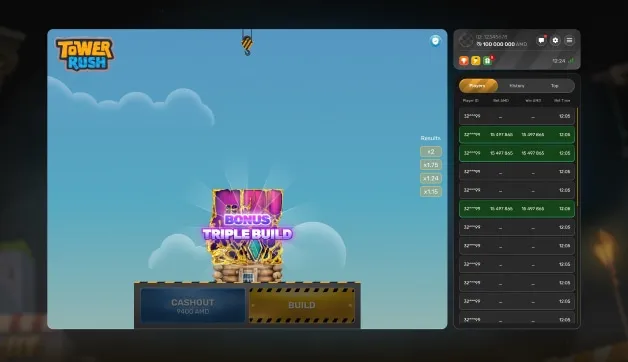
The game also features three special bonus floors: Frozen Floor, Temple Floor, and Triple Build. You do not need to infer their exact effect here; just know that they belong to the floor set and can show up as special floor types during play.
Use this section as a checklist while you read the game screen. If a rule is shown in the demo, match it to the action on screen before you start a real round.
| Rule element | What it means in play |
|---|---|
| Successful floor placement | A floor is added and contributes to the growing multiplier. |
| Cashing out | The round ends and the stake is paid using the accumulated multiplier. |
| Bonus floors | Frozen Floor, Temple Floor, and Triple Build are listed as named floor types. |
Worked example with supported numbers
If the screen shows a 2x result after one successful floor and then a 3x result after the next successful floor, the accumulated multiplier is the product of those values. In that example, the combined multiplier is 6x. If the stake were 1 unit, the cashout would be 6 units because the payout equals the stake times the total multiplier. This example uses only the multiplier rule and the cashout rule shown for the game.
Before using real stakes
Before you switch from the demo to a paid round, make sure you know where the stake is entered and where the cashout figure appears. A stake is the amount you risk in the round; it is not a deposit, which belongs to your account balance outside the game. That difference matters when you check the screen before playing.
RTP for this game falls in a range from 96.2% to 97.6%. RTP stands for return to player, a long-run statistical measure tied to the game setup; it does not promise what any single round will produce. Treat that figure as background reference only, not as assurance of a particular outcome.
The release date is 2024-02-28, and the title is available as an app as well as a demo. If you prefer a first test on a smaller screen, the mobile demo gives you a convenient way to review the interface and read the floor names before any stake is involved.
If you want to find the game in a casino catalogue, open the operator’s own game list and verify the title name directly. One confirmed example in Pakistan is Mostbet, where user-confirmed availability is noted. Do not assume every operator with Galaxsys content includes the game; confirm it from the listing itself.
A sensible pre-play routine is to open the demo, identify the multiplier display, read the cashout label, and confirm the floor names. If any part of the screen is unclear, stay in demo mode until you can follow one full round from entry to result.
Does the game use a multiplier?
Yes. Each successfully placed floor contributes to a multiplier, and the multipliers are multiplied together. The game then uses the accumulated multiplier for cashout.
What does cashout mean here?
Cashout ends the round and pays the stake multiplied by the accumulated multiplier. It is the in-game payout action, not an account withdrawal.
Can I learn the game without using money?
Yes. The demo is available, including mobile demo access, so you can read the rules and watch the floor flow before placing a stake.
Which special floors are named in the game?
The named bonus floors are Frozen Floor, Temple Floor, and Triple Build. They are listed as part of the game’s floor set.
Where can I check availability?
Search the operator’s own catalogue and look for the title by name. One confirmed Pakistan example is Mostbet.
Ready to Play Tower Rush?
Try the demo or play at Mostbet Pakistan with local payment methods.